
Cécile runs an established law firm in Belgium. Like most firms in the country, she faces a structural problem the whole profession knows well:
- How do you keep talented junior lawyers through – and beyond – their three-year training period?
- How do you reward long-term commitment when tradition favours fixed, low early-career salaries?
- And how do you align everyone's interests with the firm's long-term growth?
To solve it, Cécile uses the FlexUp model to turn part of each associate's value creation into a real, vesting share of the firm's profits and risk – without giving away ownership or control of her business.
Highlights
- Project type: Law firm
- Country: Belgium
- Team size: 4 (Cécile + 1 senior associate + 2 junior associates)
- Use case type: 🧪 simulation
Context
Cécile runs an established law firm in Belgium, built over several years into a stable and reputable private practice. The firm operates with a small, focused team: Pierre, a senior advocate, and two junior associates, Charles and Juliet.
Like many law firms in Belgium, the firm follows the traditional structure of the legal profession, where junior lawyers go through a multi-year training period. During these first three years, associates take on significant workloads, contribute directly to client delivery, and build critical expertise – yet receive relatively low compensation compared to their market value.
This is not unique to Cécile's firm; it reflects a broader trend across the Belgian legal industry. As a result, junior associates often develop both financial and emotional frustration. They know that competing firms are willing to offer significantly higher salaries once the training period ends, and they feel undervalued for the effort they have already put in.
So after completing their training, many associates leave – not because of the firm itself, but because of better financial opportunities elsewhere and a lingering sense of unfair early-career pay.
For Cécile, this creates a recurring challenge: just as associates become fully trained, productive, and valuable, they exit. The result is a continuous cycle of recruitment, training, and knowledge loss that limits the firm's ability to build cohesion, retain expertise, and scale sustainably.
Cécile also has a more personal reason to be careful about how she rewards her team. In an earlier venture, she brought people on board by giving them real shares – only to find herself blackmailed by minority shareholders who used their stake to block decisions and extract concessions. The experience left her determined never to give away ownership or control of her firm again, even as she looks for a fair way to share its success.
Deal structure
Initial Valuation (January 2022)
The firm starts with a cost-based valuation of 900 000 €, reflecting Cécile's past investment and the costs she has already incurred. This is allocated entirely to Cécile as credits.
Monthly remuneration
Each associate's monthly pay is split across firm, flex, and credit components:
| Associate | Monthly | Firm | Flex | Credit |
|---|---|---|---|---|
| Cécile (founder) | 15 000 € | 25% | 25% | 25% |
| Pierre (senior associate) | 8 000 € | 50% | 25% | 25% |
| Charles & Juliette (junior associates) | 2 000 € | 100% | – | – |
Credit allocations
On top of their monthly pay, associates receive credits that build their long-term stake in the firm:
- Pierre receives 50 000 € in credits when he joins as a senior associate.
- Charles and Juliette each receive company-granted credits that rise over time:
- 1 000 € / month in year 1,
- 2 000 € / month in year 2, and
- 3 000 € / month in year 3.
- These credits vest over three years and become liquid only once the vesting period is complete.
How the components work
- Firm pay is unconditional and always paid first.
- Flex pay is conditional, and paid when the firm has enough cash, else it converts to Credits,
- Credits sit lower still: they are loan-like and deferred, repaid later through annual buybacks if the firm generates surplus cash.
Because Flex and Credit pay carry the risk of not being paid in full, the firm compensates each associate with tokens – the firm's base unit for sharing profit, entitling holders to a share of future profit distributions and buyback proceeds. Tokens are issued the moment a flexible tranche is created, in proportion to the risk it carries:
tokens issued = tranche amount × risk factor ÷ token price
A flex tranche carries a 20% risk factor and a credit tranche an 80% one. So an associate paid partly in flex and credits steadily accumulates tokens alongside their credits – and it is these tokens, not the credits themselves, that build their share of the firm's profits. The same rule applies to everyone: founder, senior, and junior alike earn tokens for the risk they take. Because credits and their tokens vest over three years, the model deliberately rewards long-term commitment over short-term moves.
Shared profits, not shared ownership
Crucially, tokens are not shares in Cécile's company. They give associates a transparent share of the profits and the value they help create – in proportion to their contribution and the risk they take – but they transfer no legal ownership or control. Cécile remains the sole owner of her firm, fully in control of how it is run. After being blackmailed by minority shareholders in a past venture, this is exactly what makes FlexUp work for her: she can finally share success with her team without giving away her business.
Outcome
Over the simulation, every team member is paid according to this structure, combining firm income, flexible pay, and long-term credits. The result is differentiated outcomes driven by individual decisions and time commitment.
Juliette chooses to leave the firm before completing the full three-year cycle, following the traditional market pattern. As a result, she does not benefit from the long-term incentives embedded in the FlexUp model – in particular, the vesting of her credits and the tokens issued alongside them.
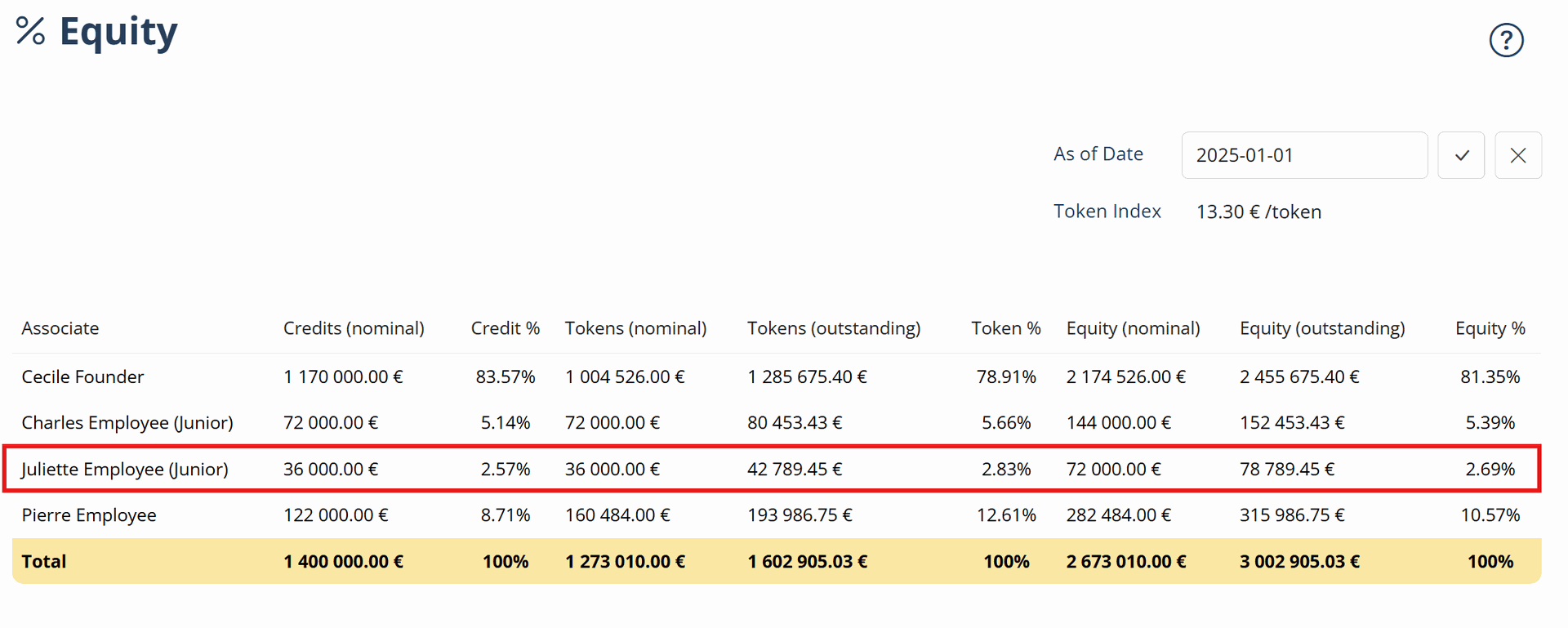
Over her first two years, Juliette accumulates tokens worth roughly a 2.7% share of the firm's profits. But because she leaves before the three-year vesting period is complete, these tokens do not vest, and she forfeits the long-term value she helped create.
Charles, by contrast, stays with the firm for the full three years. The tokens he earns as compensation for the risk on his credits fully vest, giving him a meaningful 5% share of the firm's profits – with his credits still repayable on top.
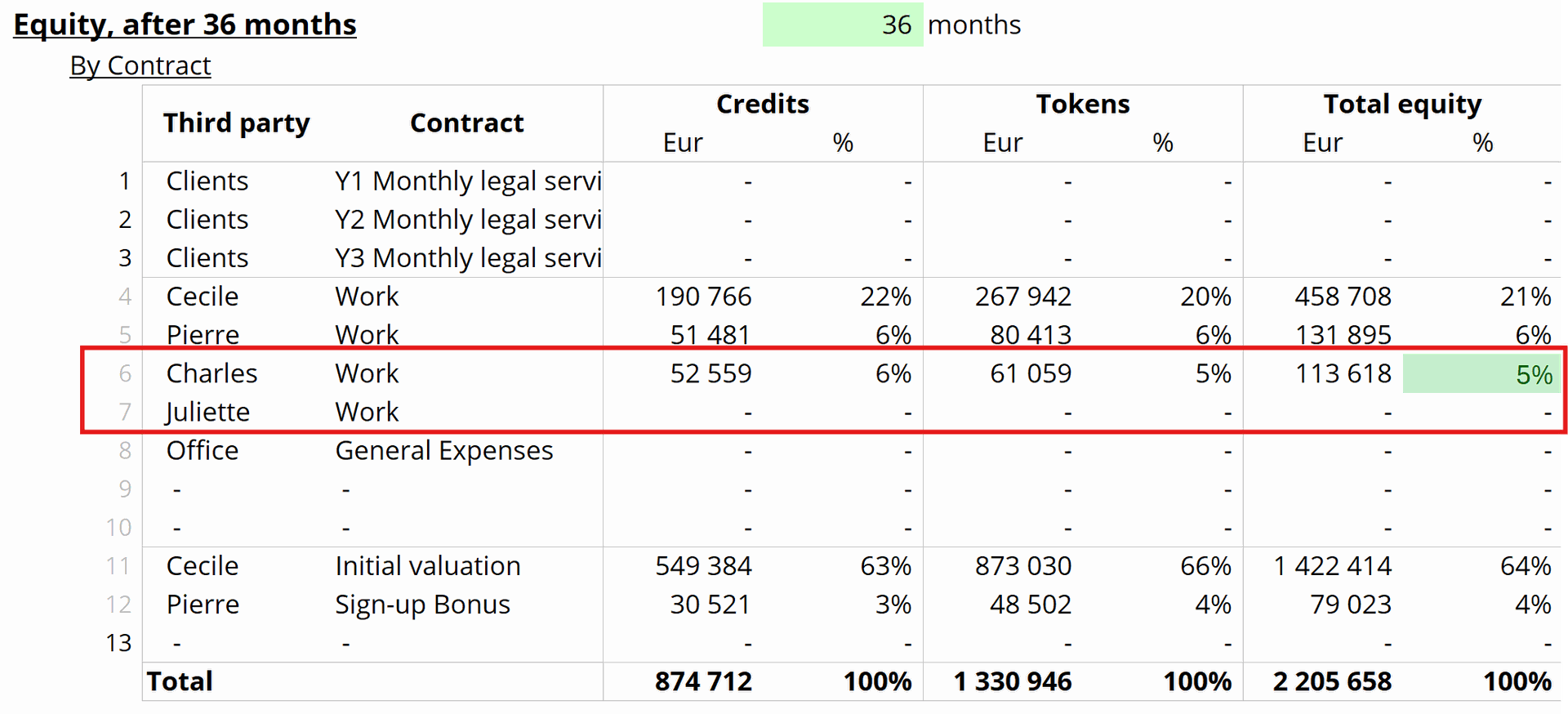
Given the firm's growth and rising valuation over the period, that stake represents significant financial upside – far beyond what a traditional salary progression would offer.
Value of Long-Term Commitment
The contrast between the two junior associates is the clearest illustration of the model:
- By leaving early, Juliette forfeits roughly 72 000 € in credits and tokens accumulated over two years.
- By staying the full period, Charles earns around 150 000 € in credits and tokens – on top of his market salary – reflecting both his continued contribution and full vesting.
This highlights the core mechanism: equity is earned through both contribution and duration. Charles is rewarded for his long-term commitment and his alignment with the firm's growth, while Juliette, despite her contributions, does not capture the same value because she left early.
Why FlexUp made the difference
Traditionally, Cécile had two options: keep paying junior associates low fixed salaries and accept the recurring loss of trained talent, or offer higher early-career pay the firm could not sustainably afford.
FlexUp offered a third path:
- A long-term financial incentive that costs little cash upfront, since credits are deferred rather than paid immediately.
- A share of profits that grows with contribution and time, turning trainees into genuine stakeholders – without diluting Cécile's ownership or control.
- The same transparent framework for everyone – founder, senior, and junior alike – with pay split across firm, flex, and credit components.
- A clear, shared view of how value accrues, agreed upfront rather than negotiated under pressure.
- A way to reward and retain talent without repeating Cécile's earlier experience of giving away shares and losing control to minority shareholders.
Conclusion
This case study shows how the FlexUp model offers a fair and transparent way to structure remuneration and profit-sharing within a law firm. By linking each associate's share to their real contributions over time, value is allocated dynamically and reflects genuine value creation.
The model is inherently non-discriminatory: the same framework applies to everyone – founder, senior associate, or junior lawyer. All operate under one structure, where pay is split across firm, flex, and credit components, and long-term contribution is consistently rewarded.
As a result, junior associates are no longer temporary trainees but become true partners in the firm's growth. By staying beyond the initial training period, they share in the value they help create and align their personal success with the firm's long-term development – while Cécile retains full ownership and control of the firm she built.
Explore further
- 📄 Download the full case study – Cécile Law firm Use-case.pdf
- 📊 Download the financial model – Cecile Law Firm BP 2026-03-19.xlsx
- 🧪 Log into our demo site to view this use case in the FlexUp app:
- Link: https://sandbox.flexup.app/login/
- Email: cecile@example.com
- Password: demo
Read other case studies
Cécile Law Firm